Edinburgh 0131 200 1200

Aberdeen 01224 49 80 80

Glasgow 0141 737 1945

Portlethen 01224 784855

The cost of administering an estate

Unfortunately, asking how much it costs to wind up an estate is a little like asking how much it costs to build a house. There are so many potential variables that can affect the complexity of the matter, and therefore the cost, that it is impossible to give an accurate indication of likely costs at the outset.  However, it is possible to give an accurate indication of how fees will be assessed and we think it is important to do so.

Legal fees

We can offer a fixed fee for straightforward smaller estates.  For non-taxable testate estates with a gross value not exceeding £175,000 which consist of only a house or flat (or share of a house or flat), furniture and personal effects and cash held in bank accounts, our fixed VAT-inclusive fee is £3,250.  Outlays are also payable (see below).  For all other estates, our fees are calculated by reference to (1) the time we spend in dealing with the estate administration, based on the hourly charge-out rates noted below, and (2) the overall value of the estate – to reflect the additional responsibility of dealing with a higher-value estate.  This element is charged at 0.5% of the gross value of the estate.  There may also be a fee augmentation not exceeding 5% to cover incidental costs. 

Time spent dealing with the administration of an estate may include, but is not limited to, meetings, travelling, considering and working on documents and making and receiving telephone calls, emails and letters.  The amount of time will be affected by a number of factors including, but not limited to, whether there is a will; whether the estate is subject to inheritance tax; the nature and number of estate assets; the number of legatees and beneficiaries; whether there are any legal rights or cohabitant claims; whether there are any international considerations; and whether there are any disagreements amongst the executors, beneficiaries and/or family.

If the fee is externally assessed by a law accountant, and the law accountant determines that it is fairer and more reasonable to do so, the ‘time spent’ fee may be substituted for a percentage-based fee for the ingathering and distribution phase of the estate administration.  The rate that may be charged on the assets ingathered and distributed ranges from 0.25% to 1.5%, depending upon the nature and value of the assets.  The rate that may be charged on the income received ranges from 1% to 10%, depending upon the nature and value of the income.

Where appropriate, we shall add VAT to our fees.

Independent assessment

Once the application for confirmation has been submitted to the court we will, unless otherwise agreed, instruct external law accountants to assess an interim fee for the work undertaken to date, and again for the final fee at the completion of the estate administration.  The law accountants’ charges will be levied against the estate.

The law accountant will determine whether it is fairer and more appropriate to apply a ‘time spent’ fee or a percentage-based fee for the ingathering phase of the estate administration.  The law accountant will also determine the appropriate level of augmentation (which may include nil) to cover incidental costs.

If the estate administration continues for a long time, additional interim fees may be raised periodically.

Who pays the fees?

The executors are responsible for paying the legal fees incurred in winding up the estate but they are entitled to use estate funds, rather than their own personal funds, to do this.  This is why we try to delay raising any fees until estate funds are, or will shortly be, available.

Occasionally, however, if there are no cash assets in the estate from which to settle the legal fees or if there is an extended delay in realising the cash assets in the estate, the executors may need to settle fees from their own funds.  In such a case, providing there are sufficient estate funds to do so, the executors can be reimbursed from the estate once funds become available.

Hourly rates

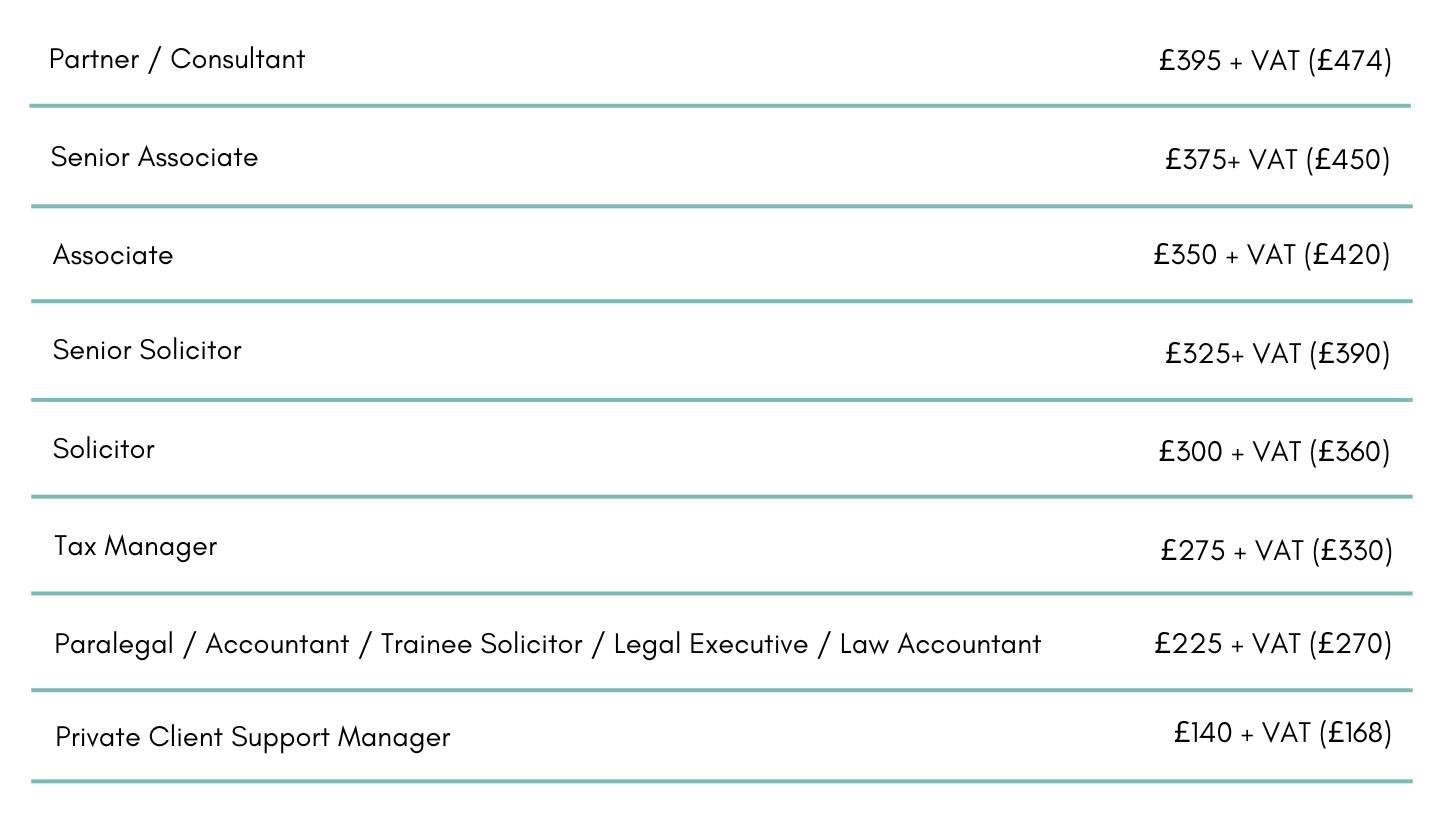
Our current hourly charge out rates are as follows:

Our hourly rates are reviewed from time to time. 

Outlays

Again, each estate is different so it is difficult to anticipate all of the outlays at the outset.  However, there are some outlays that are likely to occur in most estates.  These are:

  • Court dues for Confirmation:
    • Estate value £250,000 or less – £341 plus £9 for each individual certificate
    • Estate exceeds £250,000 – £684 plus £9 for each individual certificate
  • Court dues for Initial Petition (when there is no will) £22
  • Registration of will in Books of Council & Session: £20
  • Online client ID verification and watch-list search: up to £18 per executor
  • Beneficiary Insolvency searches £33 (separate searches required for beneficiaries in Scotland and for beneficiaries in England & Wales)
  • Bond of Caution (when there is no will) – premiums range from 0.10% to 0.5% of estate value.

House/Flat sale

If there is a house or flat within the estate this can sometimes (depending upon circumstances and requirements) be transferred on to a beneficiary within minimal additional cost by way of a simplified transfer method called a docquet transfer.  If a fully registered transfer is required or if the property is to be sold, our property department can (once the property value is known) provide an indication of the additional fees and outlays that will apply. 

Keeping track of fees

We are more than happy to discuss fees at any stage, including reporting the time that has been recorded and estimates of what is still to be done.

Let us help you

Contact us to find out what we can do to help

Our expertise